Unlike the software developed for Windows system, most of the applications installed in Mac OS X generally can be removed with relative ease. Clementine is a third party application that provides additional functionality to OS X system and enjoys a popularity among Mac users. However, instead of installing it by dragging its icon to the Application folder, uninstalling Clementine may need you to do more than a simple drag-and-drop to the Trash.
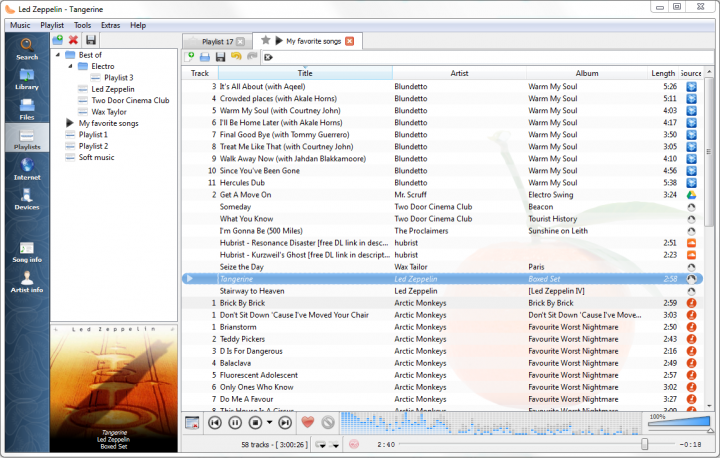
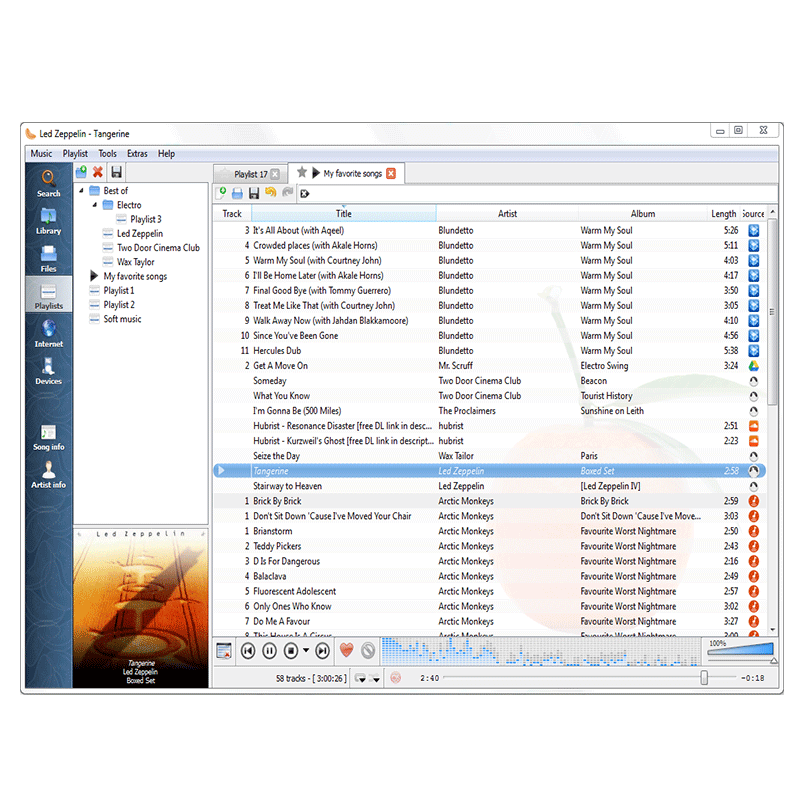
Download Mac App RemoverClementine is an open source audio player designed for Mac. This feature-rich program can successfully replace the highly popular iTunes app, being able to play your favorite songs and help you listening to various online radio shows from one place. Clementine is an open source music player that works on different operating systems and platforms. Users can play music from local computer or listen internet radio such as Spotify, Last.fm and many more. Allows to convert audio to MP3, FLAC, AAC, edit music tags.
When installed, Clementine creates files in several locations. Generally, its additional files, such as preference files and application support files, still remains on the hard drive after you delete Clementine from the Application folder, in case that the next time you decide to reinstall it, the settings of this program still be kept. But if you are trying to uninstall Clementine in full and free up your disk space, removing all its components is highly necessary. Continue reading this article to learn about the proper methods for uninstalling Clementine .
Manually uninstall Clementine step by step:
Most applications in Mac OS X are bundles that contain all, or at least most, of the files needed to run the application, that is to say, they are self-contained. Thus, different from the program uninstall method of using the control panel in Windows, Mac users can easily drag any unwanted application to the Trash and then the removal process is started. Despite that, you should also be aware that removing an unbundled application by moving it into the Trash leave behind some of its components on your Mac. To fully get rid of Clementine from your Mac, you can manually follow these steps:
1. Terminate Clementine process(es) via Activity Monitor
Before uninstalling Clementine , you’d better quit this application and end all its processes. If Clementine is frozen, you can press Cmd +Opt + Esc, select Clementine in the pop-up windows and click Force Quit to quit this program (this shortcut for force quit works for the application that appears but not for its hidden processes).
Open Activity Monitor in the Utilities folder in Launchpad, and select All Processes on the drop-down menu at the top of the window. Select the process(es) associated with Clementine in the list, click Quit Process icon in the left corner of the window, and click Quit in the pop-up dialog box (if that doesn’t work, then try Force Quit).
2. Delete Clementine application using the Trash
First of all, make sure to log into your Mac with an administrator account, or you will be asked for a password when you try to delete something.
Open the Applications folder in the Finder (if it doesn’t appear in the sidebar, go to the Menu Bar, open the “Go” menu, and select Applications in the list), search for Clementine application by typing its name in the search field, and then drag it to the Trash (in the dock) to begin the uninstall process. Alternatively you can also click on the Clementine icon/folder and move it to the Trash by pressing Cmd + Del or choosing the File and Move to Trash commands.
For the applications that are installed from the App Store, you can simply go to the Launchpad, search for the application, click and hold its icon with your mouse button (or hold down the Option key), then the icon will wiggle and show the “X” in its left upper corner. Click the “X” and click Delete in the confirmation dialog.
Download Mac App Remover3. Remove all components related to Clementine in Finder
Though Clementine has been deleted to the Trash, its lingering files, logs, caches and other miscellaneous contents may stay on the hard disk. For complete removal of Clementine , you can manually detect and clean out all components associated with this application. You can search for the relevant names using Spotlight. Those preference files of Clementine can be found in the Preferences folder within your user’s library folder (~/Library/Preferences) or the system-wide Library located at the root of the system volume (/Library/Preferences/), while the support files are located in '~/Library/Application Support/' or '/Library/Application Support/'.
Open the Finder, go to the Menu Bar, open the “Go” menu, select the entry:|Go to Folder... and then enter the path of the Application Support folder:~/Library
Search for any files or folders with the program’s name or developer’s name in the ~/Library/Preferences/, ~/Library/Application Support/ and ~/Library/Caches/ folders. Right click on those items and click Move to Trash to delete them.
Meanwhile, search for the following locations to delete associated items:
- /Library/Preferences/
- /Library/Application Support/
- /Library/Caches/
Besides, there may be some kernel extensions or hidden files that are not obvious to find. In that case, you can do a Google search about the components for Clementine . Usually kernel extensions are located in in /System/Library/Extensions and end with the extension .kext, while hidden files are mostly located in your home folder. You can use Terminal (inside Applications/Utilities) to list the contents of the directory in question and delete the offending item.
4. Empty the Trash to fully remove Clementine
If you are determined to delete Clementine permanently, the last thing you need to do is emptying the Trash. To completely empty your trash can, you can right click on the Trash in the dock and choose Empty Trash, or simply choose Empty Trash under the Finder menu (Notice: you can not undo this act, so make sure that you haven’t mistakenly deleted anything before doing this act. If you change your mind, before emptying the Trash, you can right click on the items in the Trash and choose Put Back in the list). In case you cannot empty the Trash, reboot your Mac.
Download Mac App RemoverTips for the app with default uninstall utility:
You may not notice that, there are a few of Mac applications that come with dedicated uninstallation programs. Though the method mentioned above can solve the most app uninstall problems, you can still go for its installation disk or the application folder or package to check if the app has its own uninstaller first. If so, just run such an app and follow the prompts to uninstall properly. After that, search for related files to make sure if the app and its additional files are fully deleted from your Mac.
Automatically uninstall Clementine with MacRemover (recommended):
No doubt that uninstalling programs in Mac system has been much simpler than in Windows system. But it still may seem a little tedious and time-consuming for those OS X beginners to manually remove Clementine and totally clean out all its remnants. Why not try an easier and faster way to thoroughly remove it?
If you intend to save your time and energy in uninstalling Clementine , or you encounter some specific problems in deleting it to the Trash, or even you are not sure which files or folders belong to Clementine , you can turn to a professional third-party uninstaller to resolve troubles. Here MacRemover is recommended for you to accomplish Clementine uninstall within three simple steps. MacRemover is a lite but powerful uninstaller utility that helps you thoroughly remove unwanted, corrupted or incompatible apps from your Mac. Now let’s see how it works to complete Clementine removal task.
1. Download MacRemover and install it by dragging its icon to the application folder.
Clementine Program Mac Download
2. Launch MacRemover in the dock or Launchpad, select Clementine appearing on the interface, and click Run Analysis button to proceed.
3. Review Clementine files or folders, click Complete Uninstall button and then click Yes in the pup-up dialog box to confirm Clementine removal.
Clementine For Windows
The whole uninstall process may takes even less than one minute to finish, and then all items associated with Clementine has been successfully removed from your Mac!

Benefits of using MacRemover:
MacRemover has a friendly and simply interface and even the first-time users can easily operate any unwanted program uninstallation. With its unique Smart Analytic System, MacRemover is capable of quickly locating every associated components of Clementine and safely deleting them within a few clicks. Thoroughly uninstalling Clementine from your mac with MacRemover becomes incredibly straightforward and speedy, right? You don’t need to check the Library or manually remove its additional files. Actually, all you need to do is a select-and-delete move. As MacRemover comes in handy to all those who want to get rid of any unwanted programs without any hassle, you’re welcome to download it and enjoy the excellent user experience right now!
This article provides you two methods (both manually and automatically) to properly and quickly uninstall Clementine , and either of them works for most of the apps on your Mac. If you confront any difficulty in uninstalling any unwanted application/software, don’t hesitate to apply this automatic tool and resolve your troubles.
Download Mac App Remover| Developer(s) | IBM Corp. |
|---|---|
| Stable release | 18.2.2 / September 2020; 4 months ago |
| Operating system | Windows, Linux, Unix, Mac OS X |
| Type | Data mining and Predictive analytics |
| License | Proprietary software |
| Website | www.ibm.com/products/spss-modeler |
IBM SPSS Modeler is a data mining and text analytics software application from IBM. It is used to build predictive models and conduct other analytic tasks. It has a visual interface which allows users to leverage statistical and data mining algorithms without programming.
One of its main aims from the outset was to get rid of unnecessary complexity in data transformations, and to make complex predictive models very easy to use.
The first version incorporated decision trees (ID3), and neural networks (backprop), which could both be trained without underlying knowledge of how those techniques worked.
IBM SPSS Modeler was originally named Clementine by its creators, Integral Solutions Limited. This name continued for a while after SPSS's acquisition of the product. SPSS later changed the name to SPSS Clementine, and then later to PASW Modeler.[1] Following IBM's 2009 acquisition of SPSS, the product was renamed IBM SPSS Modeler, its current name.
Applications[edit]
SPSS Modeler has been used in these and other industries:
- Customer analytics[2] and Customer relationship management (CRM)
- Fraud detection and prevention[3]
- Optimizing insurance claims[citation needed]
- Risk management[citation needed]
- Manufacturing quality improvement[citation needed]
- Healthcare quality improvement[4]
- Forecasting demand or sales[citation needed]
- Law enforcement[5] and border security
- Education[6]
- Telecommunications[7]
- Entertainment: e.g., predicting movie box office receipts[8][9]
Editions[edit]
IBM sells the current version of SPSS Modeler (version 18.2.1) in two separate bundles of features. These two bundles are called 'editions' by IBM:
- SPSS Modeler Professional: used for structured data, such as databases, mainframe data systems, flat files or BI systems
- SPSS Modeler Premium: Includes all the features of Modeler Professional, with the addition of:
- – Text analytics
Both editions are available in desktop and server configurations.
In addition to the traditional IBM SPSS Modeler desktop installations, IBM now offers the SPSS Modeler interface as an option in the Watson Studio product line which includes Watson Studio (cloud), Watson Studio Local, and Watson Studio Desktop.
Watson Studio Desktop documentation: https://www.ibm.com/support/knowledgecenter/SSBFT6_1.1.0/mstmap/kc_welcome.html
Release history[edit]
- Clementine 1.0 – June 1994 by ISL[10]
- Clementine 5.1 – Jan 2000
- Clementine 12.0 – Jan 2008
- PASW Modeler 13 (formerly Clementine) – April 2009
- IBM SPSS Modeler 14.0 – 2010
- IBM SPSS Modeler 14.2 – 2011
- IBM SPSS Modeler 15.0 – June 2012
- IBM SPSS Modeler 16.0 – December 2013
- IBM SPSS Modeler 17.0 – March 2015
- IBM SPSS Modeler 18.0 -- March 2016 [11]
- IBM SPSS Modeler 18.1 -- June 2017 [12]
- IBM SPSS Modeler 18.2 -- March 2019
Product history[edit]
Early versions of the software were called Clementine and were Unix-based. The first version was released on Jun 9th 1994, after Beta testing at 6 customer sites. Clementine was originally developed by a UK company named Integral Solutions Limited (ISL),[10] in Collaboration with Artificial Intelligence researchers at Sussex University. The original Clementine was implemented in Poplog, which ISL marketed for Sussex University.
Clementine mainly used the Poplog languages, Pop11, with some parts written in C for speed (such as the neural network engine), along with additional tools provided as part of Solaris, VMS and various versions of Unix. The tool quickly garnered the attention of the data mining community (at that time in its infancy).
In order to reach a larger market, ISL then Ported Poplog to Microsoft Windows using the NutCracker package, later named MKS Toolkit to provide the Unix graphical facilities. Original in many respects, Clementine was the first data mining tool to use an icon based Graphical user interface rather than requiring users to write in a Programming language, though that option remained available for expert users.
In 1998 ISL was acquired by SPSS Inc., who saw the potential for extended development as a commercial data mining tool. In early 2000 the software was developed into a client / server architecture, and shortly afterward the client front-end interface component was completely re-written and replaced with a new Java front-end, which allowed deeper integration with the other tools provided by SPSS.
SPSS Clementine version 7.0: The client front-end runs under Windows. The server back-end Unix variants (Sun, HP-UX, AIX), Linux, and Windows. The graphical user interface is written in Java.

IBM SPSS Modeler 14.0 was the first release of Modeler by IBM.
IBM SPSS Modeler 15, released in June 2012, introduced significant new functionality for Social Network Analysis and Entity Analytics.
See also[edit]
References[edit]
- ^'Oh My Darling! SPSS Says Goodbye Clementine, Hello 'PASW' – Intelligent Enterprise'.
- ^'The Forrester Wave™: Customer Analytics Solutions'. Forrester Research, Inc. 2012.
- ^'Us-en_software_HP'.
- ^'Us-en_software_HP'.
- ^'Us-en_software_HP'.
- ^http://public.dhe.ibm.com/common/ssi/ecm/en/imw14303usen/IMW14303USEN.PDF
- ^http://public.dhe.ibm.com/common/ssi/ecm/en/ytw03085usen/YTW03085USEN.PDF
- ^Delen, Dursun (2009). 'Predicting Movie Box-Office Receipts Using SPSS Clementine Data Mining Software'.Cite journal requires
|journal=(help) - ^Nisbet, Robert; Elder, John; Miner, Gary (2009). Handbook of Statistical Analysis and Data Mining Applications. Elsevier. pp. 391–415. ISBN978-0-12-374765-5.
- ^ abShearer, Colin (November 18, 1994). 'Mining themw-data:TemplateStyles:r999302996'>'Announcing IBM SPSS Modeler 18'. 2016-03-15.
- ^'IBM SPSS Modeler 18.1 — Coding Free Open Source, Seamless Weather Data and Optimization Integration and Text Analytics for Big Data'. 2017-06-20.
Clementine Os
Further reading[edit]
- Chapman, P.; Clinton, J.; Kerber, R.; Khabaza, T.; Reinartz, T.; Shearer, C.; Wirth, R. (2000). 'CRISP-DM 1.0'(PDF). Chicago, IL: SPSS.Cite journal requires
|journal=(help) - Nisbet, R.; Elder, J.; Miner, G. (2009). 'Handbook of Statistical Analysis and Data Mining Applications'. Burlington, MA: Academic Press (Elsevier).Cite journal requires
|journal=(help) - Khabaza, Tom (1999). 'The Story of Clementine'(PDF).Cite journal requires
|journal=(help)
External links[edit]
- [1] SPSS Modeler 18.2.1 Documentation
- Users Guide – SPSS Modeler 18.2.1